toki pona has 9 consonants:
| letter | English example |
|---|---|
| j | fjörd, yacht |
| k | scorching, scrap (unaspirated) |
| l | clap, slot (pronounced like a distingushed Brit [unnasalized]) |
| m | mat, impure |
| n | know, gnat |
| p | sporadic, spin (unasiprated) |
| s | see, sign |
| t | stall, stick (unaspirated) |
| w | wait, award |
and five vowels:
| letter | English example |
|---|---|
| a | bath (Scottish English) |
| e | air (Standard American English) |
| i | see (approximately) |
| o | or (Standard American English) |
| u | pool (Standard American English) |
as seen above, toki pona’s letters follow the IPA, meaning j sounds kinda like a y.
toki pona, unlike English, uses lowercase letters, even at the beginning of a sentence, except for the start of proper nouns, which we'll get to later.
toki pona also has a non-Latin-but-equally-as-standard writing system, known as sitelen pona (), meaning “simple writing,” where each word gets its own symbol (because toki pona only has, like, 130-something words). modifiers (basically just words in their adjectival form) go inside of the noun’s symbol, as in toki pona , but if they can't fit, they go above, as in ilo moku , meaning “food tool” or “utensil”.
there's also a kind-of-unofficial-but-featured-in-the-official-book writing system called sitelen sitelen, also known as sitelen suwi, and it looks like this (the following says “toki pona li pona mute tawa mi.”):
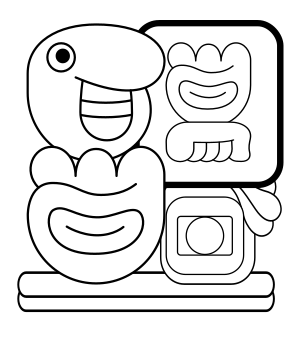
we're not gonna be learning that one, though, because I feel like two writing systems is enough and I don't wanna overload you with information.
table of contents next lesson!